Taking the Guesswork Out of Consult Calls [and Finally Living Her Dream]: Kassandra's Story (Episode 80)
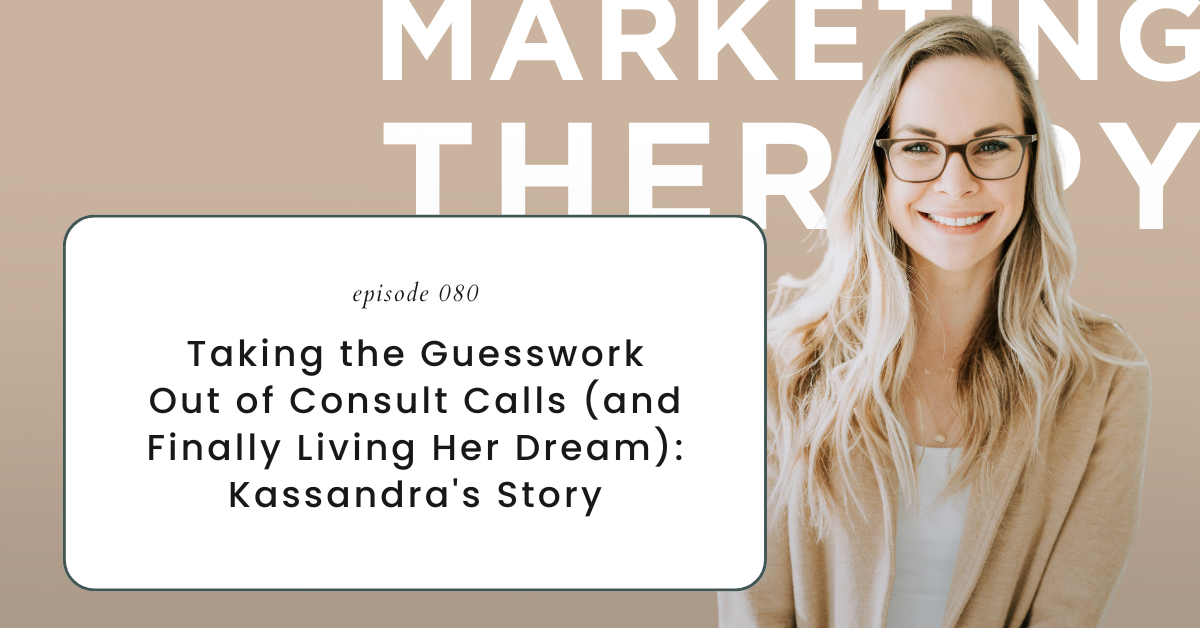
Building a successful private practice rarely follows a straight line. In this special guest episode, Anna sits down with Kassandra Balandrano, a therapist in Austin, Texas, who shares the honest story of leaving group practice, discovering her niche, and building a private practice that genuinely fits her. From questioning herself along the way to landing ideal-fit clients—including one who found her through ChatGPT—Kassandra offers an encouraging reminder that clarity comes through action.
Together, Anna and Kassandra explore what it looks like to trust yourself as a business owner, embrace a niche that feels authentic, and create marketing that attracts clients who are truly aligned with the work you love to do. Whether you're just starting your practice or wondering if your marketing efforts are paying off, this conversation is full of practical insight and hope.
Here’s what you’ll learn in this episode:
1️⃣ Why trusting yourself is one of the most important skills you can develop as a private practice owner.
2️⃣ How getting clear on your niche leads to more fulfilling, better-fit clients.
3️⃣ Why marketing isn't just about filling your caseload—it's about creating work you're excited to show up for.
4️⃣ How taking imperfect action helps build confidence and momentum in your private practice.
-
Hey, hey. I'm so excited about this episode of Marketing Therapy, where I am sitting down with Kassandra, who is a clinician in Austin, Texas, and shares her really raw look at what it's been like to build a private practice, to go full-time as a pre-licensed associate in Texas, the process of finding out her niche, of questioning herself.
But on the flip side, of getting on consult calls where she already knows the person is the right fit, getting her first client from ChatGPT, who she said is a perfect fit client And just so much insight and encouragement for anyone that is finding themselves perhaps questioning things or wondering what to do next.
Kassandra is such a fantastic representation of what can happen when you trust yourself, when, as she says, you give yourself a seat at the table of private practice. Mm-hmm. You trust yourself, and you do the hard work of figuring out who your ideal client really is and start putting yourself out there in a really authentic way.
I can't wait to hear what you get from this one. Let's dive in.
Kassandra, welcome to Marketing Therapy. Thank you so much for being here. Tell us obviously your name, where you're located, and a bit about your niche
Yeah. So my name's Kassandra. I'm a licensed professional counselor associate based in Austin, Texas. I opened my private practice in April of 2025, but I didn't go fully solo until November of last year when I decided to leave a local group practice. So yeah, I've been, been on my own for a little bit.
I would define my niche, I call it relationship therapy. I really love helping women and couples build compassion and connection in their relationships, and I think that also includes ourselves. I think a lot of the times we think of relationships as just outward connections, but I also think a lot of the times we kind of neglect our own relationship with ourselves, the way we talk to ourselves, the way we think about ourselves, believe in ourselves.
So yeah, I feel like it-- with my niche, that looks like helping women and couples examine their patterns with, like, anxiety or self-esteem and any, like, painful relationship dynamics that are coming up
Okay, awesome. Tell us a little bit about how you came to this niche. How did you land on relationships? How did you land on women and couples? What sort of led you in that direction?
That's a great question. I'll start with the couples piece first because that kind of was unprompted or just unexpected for me. During my graduate program in my last semester, I kinda had, like, a freebie class opportunity, an elective basically, and I saw an opportunity for couples, and I was like, "Oh, that's fun."
Like, I don't really know much about couples work. Like, I think it would just be a growing opportunity. And it ended up really sparking this, yeah, motivation, desire to work with couples. I actually got, Gottman Level 1 training out of it, so that was really wonderful. And also, I got, a pre-marital facilitator certificate.
And so I learned a lot through that about what it would look like to work with couples, and so I feel like all of my supervisors over the years have kind of just been like, "You should try it. You should really, like, sink in." And so I did, and then it ended up being something I, I really enjoy. I always tell people that working with couples is there's really high highs when things are, like, going great, and they're big wins.
But then for me, I don't know, low lows when things are more hard, and I'm like, "Ugh, man, that's tough." So I really like supporting couples kind of through the ups and downs of that. But long-winded way to answer that,
Yeah, that's kind of the, the couples piece of how I ended up in this niche. I would say for women, I feel like a lot of therapists resonate with their niche to some capacity.
Like, they have some life experience with it and I definitely do for mine. I've, I call myself, like, a recovering people pleaser and perfectionist.
I remember you using that in confident copy actually, like describing yourself that way. Yeah. Mm-hmm
Yeah, and it... I mean, it's true. I'm getting better over the years, but I resonate with that, and I know what that's like. And so I think the level of camaraderie that you can have with clients when you can resonate with the thing they're going through helps them feel safe in your room and helps them feel like you really do understand.
And by no means, I don't think you have to obviously have all the exact experiences, but just being able to genuinely say, like, "I get that," or like, "Ooh, I've been there. You're reading out of my diary," I think, and say that authentically, goes a long way
Yeah, absolutely. I think a lot of times when clinicians are thinking about their niche, it is some element of their own experience or something they've seen in their life, if not their own identity, something that they've, you know, had in someone close to them. So yeah, there's just something to be said for being in the room with someone who actually, actually understands, right?
That's really, really powerful. Okay, I also wanna know, Kassandra, about your journey to private practice. So obviously in Texas you're able to have your own practice. So what sort of led you to the decision of private practice, deciding to open your doors in April of 2025? Tell us about that kind of journey and that thought process.
Yeah. It's so funny because when I got my associate license, I remember telling friends and just kind of myself, like, "Oh, I have, no desire to be in private practice anytime soon or do my own thing. That's a lot of responsibility." Really, I just kind of wanted to, I don't wanna say coast, but just have a therapist hat on.
And honestly, I would say that kinda similar to the couples thing, it just kind of... The opportunity came up, and it just seemed right and appropriate. Leading up to me opening my practice, I felt really stuck. I was working actually at two group practices, one in person and one virtually. And I feel like the appeal of group practices typically is, like, the stability of caseload, and you get to just wear your therapist hat.
They do all the marketing. They do most of the admin work, right? And unfortunately, that, wasn't true of my experience. Like, all the kind of promises that were given to me upfront didn't follow through, and, you know, part of it's out of anyone's control. But kind of in my mind of, was like, well, if I'm having to wear all these hats anyway, or if I'm not getting what I wanted out of the group practice experience anyway, like, why don't I just bet on myself?
Why don't I just, invest the time in marketing in my own practice versus someone else's practice? Spend the time really, exploring what niche I wanna do or, like, expertise I wanna have. Yeah, and I was like, "Why wouldn't I do it for myself and, also get paid?"
Of course. Sure, all of the, you know, get all of the paycheck too.
So that was a plus. But yeah, that's, that's ultimately kinda what, what led me to that is, well, I'm doing it for somebody else. Why don't I just do it for myself?
Yeah, absolutely. I have to say, I really resonate with that part of your story 'cause I also was never like, "I'm never gonna have a business. Like, I'm not an entrepreneur."
For years and years and years I always thought that, and then here I find myself, you know, running Walker Strategy Co. So sometimes that happens. But it's interesting to reflect on that. What challenges did you face early on as you made that decision and sort of were staring down this idea of opening a practice?
Yeah, I think the first one is or was figuring out my voice and my niche which I think a lot of obviously therapists probably struggle with, and that's why, you know, your company exists is to help people find their confidence and strength in that. But I think something specific for me was as an associate, I do have less time of experience to kind of have explored and figured out, okay, like, where do I find myself to be really passionate or good at?
Because especially even, a year ago, I was still kind of like thinking as a question mark, like I don't really know. And then I was doubting. I was like, well, maybe I just have nothing to offer then. Maybe I, you know, don't have anything unique to offer because of my lack of experience or because I'm not trained enough in XYZ or whatever.
So really, I would think that was the biggest challenge in the beginning, is just believing I had a seat at the table of running a private practice. My own, yeah, mental games, mental hoops and just kind of getting through them and not letting my own mind, limit what I could do. And really, what I told myself was, you know, you have permission to try, and if it doesn't work out, it doesn't work out and you just find another way because you always have.
And I think giving myself that permission to, quote, like, "fail," was very, helpful in giving me the confidence to just say what I wanna say, do what I wanna do, promote myself the way I wanna promote myself and see what happens
Yeah, right? And trust yourself that if it didn't work out that you could pivot accordingly, right? That there were other things available to you. You weren't married to this forever
Right. Exactly. Yeah, and, you know, obviously I'm here a year later, and my practice is still going, so that's not what ended up happening. I didn't have to pivot. So I'm really glad. I'm really glad I didn't let that doubt, overcome me
Yeah. When I meet with a lot of pre-licensed clinicians or those that are earlier on, I think they face those same doubts and fears around niching in particular. Like, "Well, I don't have as much time under my belt," or, "What if I enjoy something else, you know, down the road that's different from right now?"
So I think that permission to evolve should... Like, it sounds like also sort of applied to your niche, where it was like, "This is what I enjoy now. Maybe I'll learn more about it later." But something where it's like, no, I have... I- like you said, I have a seat at the table. I have a point of view. You, you know that there's work that you enjoy, and you go from there, right?
Yeah. And I think specifically with my niche, it's very, It, it's like putting up a mirror to myself, because how am I supposed to encourage my clients to, trust themselves or, give themselves a seat at the table, let themselves share their needs with others, express themselves, if I'm not doing that myself?
And so I feel like every day I'm challenged with the, you know, the same things and that I'm offering or encouraging my clients to do. So they also inspire me and, like, keep me going
Yeah, to do the
There's a lot of humility in that statement. I love that. So right around the time that you were deciding to open your practice, you also joined Confident Copy. Do you remember how you first discovered the program?
Yes. I joined your Facebook group and I saw you promoting like a free webinar on marketing a full-fee practice. And at the end you introduced Confident Copy, and I wasn't re- I didn't really have a marketing strategy at that point when I was trying to build the practice. But I knew I didn't know a thing about marketing, and the way I kind of saw it is I could either a time investment or a financial investment.
Like, I could spend the time to learn about marketing, you know, as a marketing a private practice, but it would be hours and hours of researching random articles and videos and podcasts. And I was like, I could do that, but also I could just, you know, financially invest time with somebody who knows already how to do that and can teach me how to do it.
And to me, that felt like a worthy investment because I was so eager. I was just so eager, so ready, so excited about this new chapter and I was like, I don't wanna slow myself down and get discouraged if, you know, I don't really know how to do the marketing thing. And I'd rather also be in like a community and like be supported by others, learn from others versus like...
I think one of the big gripes about private practice is it's isolating and I was like, this is a way to make it less isolating, is make myself a part of something and learn with other people, so.
I think that's one of the most incredible parts of the Confident Copy cohorts is just the community that comes with it. And I remember how eager you are, you were, and I remember your copy. I mean, I, I, like, I opened up your website, you know, prior to us pressing record this morning and I was like, "I remember reading this," and just how you just had such a voice and a point of view.
As someone who... Like, I didn't know you know, how licensed you were when you came into, you know, Confident Copy, but you did. There was a strong point of view, there was a strong voice, and in this market, we are seeing the way that that is essentially your most valuable asset, right? When you reflect on your time at Confident Copy, what kind of surprised you maybe the most about your growth or just the process in general?
Ooh that's a great question. I think honestly, not to toot my own horn, but that I wasn't half bad at building my website.
Yeah, I agree with you
I found it to be a really fun process. Like, I- the ADHD kicked in, and I- I'm usually very good at boundaries of, like, work ends at 5:00. At that point in my life, I was up till midnight, working on my website, and not because I didn't want to.
I was just like, "I want this to look exactly how I want it to." And again, was feeling so inspired and so creative, and I ended up loving the end result. And we kind of talked about this earlier, but, to this day, I still get random compliments on my website. Like, people will comment on your Facebook group page, from comments I've made months ago, and they're like, "Oh my gosh," like, "what template did you use?"
And it's, it's really cool. So it, it also built confidence in me in that, like, okay, maybe just because I didn't know a lot about marketing in the beginning doesn't mean that I can't be good at it or, like, have, you know, an aptitude for it
Right. Right. Yeah, maybe like you said, you're not half bad at this. That's awesome. Okay, so you launch your beautiful website, and I was telling you before our senior designer, Erica, who designed the Sage template, still talks about your website and how beautifully you adapted it. So we're all fans of it around here.
But anyway, you launch your website. Then what did you do? 'Cause we know that, you know, when you launch a website, it doesn't exist in a vacuum. It's not just gonna all of a sudden you build it, and they will come field of dream situation. So what did you do in your marketing?
Ah, yeah, great question. Honestly, I think something I did that I recommend for anybody is to know your city. Like, know the vibes and know how to connect with the community. So for example, like I live in Austin. I feel like it is a very, I would say, like busy, activities-based city. Like, there's a bunch of nature.
There's so many clubs. There's literally a club for anyone and everyone, and if you go to any coffee shop, there's likely a bulletin board there or sometimes even just like a wall. Like, people just tape walls of posters and flyers. And so I was like, "I'm gonna capitalize on that." And so I did the flyers and, you know, surprisingly, honestly, that's been like a pretty decent like place where I get referrals.
That's awesome
I did the flyers. I also... Let me think. I'm trying to think of like a year ago, what was I doing? Networking was a big one. Networking was a really big one because I was like, I am still like new kind of to this, you know, the new to the private practice community and I was like, I want to meet other people that, one, I can become genuine friends with, but also that I can trust and like genuinely refer my clients to and know that they'll be in good hands.
That was really important to me. And so I kind of made a commitment, like I'm gonna connect with somebody at least once a week. And I reach out via email or like on social media and being like, "Hey, like I see that you do this. I really admire that. Would love to hear more." I would say those were definitely the, the main two marketing strategies that I took
Awesome. Awesome. And then you mentioned that you went fully on your own in November. What led up to that decision? 'Cause you'll, you'll be coming up on a year of that here soon
Yeah, that's a great question. I... So in my personal life, I kind of had this revelation that I really needed to simplify. I've spent most of my life having my hands in several baskets, right? Whether it was with, you know, school and other activities or, like, having several jobs at once. And I just was like, I'm tired of this.
I'm tired of feeling like my mental energy is just spread so thin across so many things. Like, that doesn't work for me in my brain. And so with that came like, okay, I have my private practice. I want it to grow. That's my main priority. I felt like it was pretty stagnant while I was also at the group practice, and I kind of came to the cl- conclusion that I was like, I just don't have enough time to invest in it for it to grow.
And so that meant like kind of, again, taking another risk of like, I'm gonna let go of this somewhat stable-ish group practice job and, fully just trust myself and go all in. And also hopefully that would give me, the mental load and the mental clarity to grow the practice because I just get to focus on that one thing.
And that's exactly what happened. Like, if you see my analytics, it's kind of crazy, like how much, how many more like intakes I got inquiries and, Yeah, it, it like literally that month it just like skyrocketed. I think part of it is SEO kind of kicked in 'cause it was like around the six... a little more than six months mark.
So I also attribute it to that, but also I think because I was giving it the time it deserved. It just...
Interesting.
I sowed the seeds, and I feel like it was finally able to grow
Yeah, I was gonna say whatever that saying is about, like, where your energy goes, the, you know, the results flow or whatever, whatever that saying
Some physics saying.
yeah, exactly. I was never good at physics anyway. Sorry, Mr. Kindt. He tried. But I love that. So that's really interesting is you were able to sort of shift your energy, and what did that, like, renewed investment look like?
Like, what were you able to do once you left the group practice that you couldn't do before?
That's a great question. I was able to honestly, make more time with my networking contacts, and not just, over coffee, but it's, really get to know people. So being able to just dedicate my time to private practice, I was able to expand my network a lot more and invest more time in it. 'Cause like I said earlier, maybe I would, have a Zoom call or, a coffee with somebody once a week prior if I could.
But n- at this point I was able to, actually take time to get to know people, like a longer periods of time. There was a brief period last year I was, like, hosting this gathering for therapists, and I think it was called Craft and Hang, and it was just kind of an opportunity for therapists to come and if, you know, they ha- if they're a creative and they have a project they're working on, they could just come, bring it, work on it.
Or we would, like, s- offer supplies like coloring books or bracelet making, whatever, and just give people a chance to, like, relax, unwind, and kind of focus on themselves, but also, get to make some c- you know, meet some people in the community. And I wouldn't have been able to do that while being at the group practice.
So yeah, I'd say really investing in the community of therapists locally was what I was able to do
Yeah. And what did you see come from that? 'Cause, you know, I talk about networking is, like, it just reigns supreme when it comes to marketing, so I love knowing that that's some- a place that you invested. But I think a lot of people are like, "Okay, so I host a bracelet making hang, and, like, and then what?"
What have you actually seen come of those efforts?
Mm-hmm. I think, one, you have to be curious about other clinicians. Like, I don't think you can just go in and be like, "Okay, well, people know my name now, so they're gonna, send clients to me." I think you have to genuinely go in and be like, "Well, what do they have to offer?" Like, what... How can I encourage them and empower them?
Because I imagine they're in a similar spot as me, is like they want clients too. They want the right clients to find them, and how can I help support them in that? And I think that naturally just becomes reciprocal. So for example, with the Craft and Hang event, there was somebody there who was, like, an art therapist.
So it's like, great, now I have somebody I know who's, a really fun art therapist and, like, I've talked to them. I can vouch for them. And so kind... That's what I was saying earlier, right? Is, like, building that trusted network, just- not just a you do this, so I'm gonna send my client to you. It's like, no, I've gotten to know you.
I feel like our values align. We get along great. You know, getting to hear their story. And that's really what I think makes it into something that gets you inquiries, can become something where you can build your caseload because people start to trust you, but I think you also have to be, like, invest in them
Mm-hmm. Absolutely. I couldn't agree more. Okay, so you're coming up on a year of being fully you know, on your own in, in private practice. What does your marketing rhythm look like these days? What are you doing in terms of marketing on a regular basis?
Continuing the networking is a big one. So reconnecting with... Sorry, I know I'm talking about networking a lot,
And that's okay. No, like I said, it reigns supreme
Yeah, and it's really like following up with people so it's not just connecting the one time. It's like when I, somebody pops in my head and I think about them, I will immediately email them, be like, "Hey, I'm thinking of you.
How are things going? Would love to grab a coffee." And again, I think because that comes from a natural place and, right, like they just popped in my head, I think that just leads to genuine connection. So
Yeah
that, I've been continuing to do that, and I have yet to feel lonely in private practice. I would say another marketing effort is I'm starting to connect with local businesses.
That's kind of like my stretching area right now. I went to the dentist and I-- the dentist makes me very anxious. Don't love the dentist. And so I brought, my earbuds and I brought, my little fidget, squishy toys and I had my breathing exercises, like, ready to go, and they were like, "Oh, your, like, fidget toy's so cool," or they were asking me stuff because I was a therapist and I was like, this is a great opportunity for, education.
Like, next time I'm going to, probably bring some goodie bags and be like, "Hey, if you have clients who are like me and get super anxious, here are some tools you could give them, and here's a little pamphlet with, you know, maybe some, scripts that you can give them if you don't quite know how to help them through that."
So yeah, just really seeking out opportunities basically, like, where I think my clients are going. I mean, most, say, people go to the dentist, people go to the doctor. I mean, I work a lot with women and couples, so it's like, okay, well, where do they hang out? Like, well, maybe they go to the gym or maybe they go to that Pilates class or pelvic floor therapist, whatever it is.
And really just trying to connect with the local businesses as well. That's kind of my, my current endeavor.
I love that. I love the language stretch area too, where it's like, okay, the networking, the relationship building, the maintaining of that feels really good. But then what are, what are you kind of stretching or getting more creative about? What I think is really cool about you, Kassandra, is you're not doing the like, you know, X plus Y equals Z kind of marketing where, that so many people want.
They're like, "Well, I make a website, and then I ran Google ads to it, and then I got clients." Like, you're doing the more organic things that actually work right now but require some creativity and some, you know, some time and effort. But you're, you're really seeing that pay off, which I think is incredibly inspiring for people who feel intimidated by the idea of networking
Yes. Yeah, it, it does pay off. I mean, but I also wanna set, like, realistic expectation of,
Right?
I will be the first one to sit here and tell you, like, I'm not... I don't have, like, a booming caseload, and I have a, you know, where I have a wait list. Like, that's not my reality right now. Which is o- which, that's okay because, oh my gosh, like, I'm only, like, one year in my practice.
You know, I think from any context in any business, getting through that first year is usually the hardest. And so again, exercising what I encourage my clients to do, that self-compassion of you're doing a lot of work, and you know that it kind of takes a while for, you know, you to bear the fruit of that, and it can feel really heavy in that, waiting period.
I tend to get impatient. My husband knows that. So really just being kind to myself in those moments where I feel like it's not enough and, or, you know, I'm not as, quote, "successful" as, you know, maybe I should be at this point, and realizing, like, oh my gosh, Kassandra two years ago would just be absolutely stunned at w- what I'm doing right now and at my caseload and how inspired and creative I'm being.
Like, this is her dream. And, really honoring that, yeah, at this point in time, what I'm doing now was once something I thought I could never get to do, and just really being-- taking time to be grateful for that
Absolutely. That's incredible. And yes, I am all about, you know, we, we see, like, the flashy, like, "She filled her caseload in two weeks, you know, and is making 300K a year." Like, we see those stories out there. That is not the experience of most people, and in this market in particular, patience is one of your greatest assets.
So I love that you're, like, yes, in a year in, you may not be exactly where you want to be, but look at how far you've come, kind of. You know, w- honoring that, being proud of that, like you said, paying attention to the efforts that you have made and who you are compared to two years ago, that alone is worth celebrating, and you have the entire rest of your career to continue getting where you wanna go
Exactly. And, you know, I do think of it as like, okay, well, like, let's just say I did have the full caseload and was making the 300K a year, then what? You know? Like, what would I do then? Like, I... If that was my circumstance right now and I'm only a year in, I feel like I'd kind of be at a question mark or a standstill and be like, "Well, I don't really know what's
building and working right now
Yeah, and so I think that's just part of the journey, and I think accepting that and knowing that I'm not the only one, because social media's deceiving. Like you said, all the catchy phrases and the really big flashy testimonies, which happy for those people, but also, like, there's so many people who aren't posting that they're going through the summer slump, or they haven't had an inquiry in over a month, and those are real things.
And I think that's when insecurity can take over and lead you to go, inward and be like, "I don't want people to know that," 'cause that's not the stories that are being showed on social media. So for anyone listening, I want you to know that that's my story of like I definitely, again, don't have the wait list, not making, you know, the crazy six figures a year.
But maybe one day, but for now I'm just kind of, enjoying the process where I'm at, because it's... It, it was my dream at some point.
I love that. I love that. You are actively in the dream that you had, which is incredible. How are things going in your practice today? That might mean, you know, your actual caseload numbers, but, you know, what else feels good? You're, you're not stretching your energy thin across all of those, you know, different initiatives and things like that.
So how are things going?
Things are going really well. I think the fantastic part of really getting your niche down and marketing that well is the clients that you receive because they typically, you know, obviously resonate with the niche that you're offering. And I just, I love all my clients so much, and I've been able... I think my work is very fulfilling right now because I connect with my clients so well.
I no longer... It's pretty rare. I'm gonna say no longer. It is rare that I get the Sunday scaries. I asked my husband about this morning of like, "What do you feel like is different in me now versus when I was in two group practices and just trying to figure it out?" And he was like, "Oh my gosh, you're like way less anxious.
You're not dreading your week anymore." 'Cause that's how I used to feel. And now I, I wouldn't say I jump out of bed 'cause I'm not a morning person, but I get eager to go to work and be like, "Ah, I can't wait to work through this thing with this person," or, you know, "I can't wait to talk about this and support them through that."
And that's just such a, again, fulfilling sensation and, and feeling that I get to have because of the work I've done in my private practice or to build my private practice. Like most people right now, I'm also going through the summer slump, but I'm choosing to not kind of, what do you call it, grovel in it.
I'm trying to use it as an opportunity to redirect my focus towards some creative endeavors I have right now and just some admin tasks that get to, you know, tend to get put on the back burner
Right, right. Being productive with that time instead of, like you said, wallowing or groveling in it, that kind of thing. Absolutely. What's interesting for me is, you know, you could make the, whatever, crazy amounts of money in your practice. You could also hate your caseload.
And obviously, the ideal would be making all the money in the world, if that's your goal, and loving your caseload, but there's, there are so many wins about just being able to open up your calendar and be like, "I'm excited about seeing that person." Or, like you said, I feel the same way. I know something's wrong if I'm getting the Sunday scaries.
To, like, enjoy getting to go to work, what a gift, and this is work that you have created, something you are building. There's so many wins and beautiful things packed into that
Yeah, I think that was honestly the shock factor for me of seeing my marketing efforts work. Like, I remember I received one client because she was like, "I asked ChatGPT," like, or, "I told them I wanted-- I'm looking for a therapist. I told them what I wanted, what I'm struggling with," and they were like, "Your page popped up, and I resonated with it."
And when that happened, I was like, oh my gosh, it works. Like, and I-- my work with that person has just been incredible, and I would call them an ideal client. And it's just... I don't know. I can't even put it into words just how cool it is to, to be able to speak to the women and couples that, like, I just so intensely, wanted to meet.
Like, you know? Like, that's what I did all those efforts for, and then it actually coming to fruition and getting to, like, live that through every week when I go to work, like, is just so, so fulfilling
I love that. It's easy to lose sight of those things, I think, in the, in sort of the day-to-day. But yeah, like, you put in the effort, you figured out your niche, you created a super compelling website. You've put in the efforts when it comes to marketing, and then someone finds you from ChatGPT and is a perfect fit client.
Like, oh, look at that whole process. That's incredible, and what you did to make that happen.
Mm-hmm. Yeah, versus the group, you know, the group practice scenarios I was at. I mean, I think it's typical outside of any, you know, therapy position when you're not in private practice, but you kind of get a new client, and you're like, "I don't know." It's like roll of the dice. Like, they could be struggling with addiction, they could be struggling with, you know, depression or anxiety or, you know, some really intense, like, trauma.
And I just remember feeling so anxious of like, "Okay, I guess I gotta do a bunch of research now," or like, "I guess I gotta kinda wing it," you know? And it was just... I felt like I was on the edge of my seat all the time, whereas now, I mean, I still, I always try to have a growth mindset. I think there's always opportunities for me to learn new things.
But I think for the most part, when I have a client reach out to me, I can say pretty confidently, like almost every time in my, like, 15-minute consultation calls that like, "I can help you." Like, I was like, "You are speaking to my website right now." Yeah, and, and that's just such a good feeling to be able to say confidently and genuinely, like, "I, I know how to help you," or "I feel very confident that I can support you."
And I think that is what helps me, you know, continue to go to, to thrive in this work and not get burnt out, is that I feel confident and I feel content with the people that are, you know, coming in
Yeah. That's the thing I think about embracing the fact that you're the right fit for some people and not the right fit for others, and that if your marketing can be bringing in people who align with you, who you're going to be able to confidently support, who just are the, the type of person that is gonna get the outcomes that they want from your work together, it's good for everyone.
It's good for you, it's good for them, right? It's in service to everyone involved
Yeah. Something I tell people in consult calls if I maybe feel like it's not a great fit or if we've been working for a while and things have been feeling a little off, I mean, I, I'm very honest with my clients. I'm like, "I don't want you to waste your time or your money because those are very valuable things."
And I think because I tend to work with people who people please or, you know, maybe worry about stepping on toes, I kind of have to give them that permission of like, "You're not gonna hurt my feelings. Like, I'm not gonna be offended by you being honest with me if this isn't a good fit."
And I think that's just so, one, a great way to model to them that, you can say no and you can change your mind. But also, like, gives them the freedom to, invest, you know, their, you know, their time, again, and their, their financial investment in somewhere that they feel like is actually gonna give them what they want, and that that's okay if it's not me because I know, I know the population I can serve and who I can help, and if that's not them, then that, that's fine.
Yeah, staying in your
are out
of genius.
Mm-hmm.
Right. Right. All right, Kassandra, this has been wonderful. As we kind of wrap up, there's lots of people listening probably right now who can resonate with parts of your story, either who are brand new to private practice and pre-licensed, and like, who am I to pick a niche, or who are a little bit discouraged with where they are a year into their practice, whatever that might be.
What would you wanna tell them if they're in a similar place that, that you were?
Ugh. First, I'm giving you a virtual hug, 'cause that's such a tough place to be in. And also, you're not the only one doubting or questioning or feeling lost. Nobody on this earth has it all figured out. Nobody. I don't care what social media is telling you. I don't care what the ads are telling you. I don't care what the person with the full caseload is telling you.
You don't know what those people are sacrificing to have what they have. And, you know, I, I think of the... What is the phrase? It's like social media is like a highlight reel, and I think that's just so true. Like, you're getting a snippet and, maybe that is a part of their story, the success that you're seeing, but that's not the whole story.
Again, you don't know how they got there. But you know your whole story. You know how much work it's taken for you to get where you're at. So in that way, it's an unfair comparison. And truly, at the end of the day, we're all just living life for the first time and just trying to do the best we can with the tools we have.
And, you know, any thought that you've had or doubt or concern you've had, can almost guarantee some other therapist has had, let alone business owner. So
Yeah, absolutely. You're not alone in this, right, you said. I love that. All right, Kassandra, thank you so much for being here. If people want to see your beautiful, incredible website or connect with you in another way what's the best way to find you and reach out to you?
Yeah. The best way is to, yeah, contact me on my website. I have a contact form on there. My website is thehealingcottagepllc.com. And also, if it's all right, I would love to kind of plug that I do have, like, a fun project coming up. I'm gonna do a newsletter, but it's not just gonna be a, like, email newsletter.
I'm actually gonna send out physical mail because I just love the idea of going more analog. So be on the lookout for that.
I love that. Excellent. If people wanna know more about that or, like, get on a wait list or whatever is the, is your website the best place to let them know?
Yeah
Okay, awesome. Kassandra, thanks again for being here. Thanks for sharing your story and being authentic, and we are cheering you on as, as you head into this next season of practice
Thank you so much, Anna. I appreciate you
Absolutely.
Isn't that such a fantastic story? I left this interview feeling so encouraged and inspired by what Kassandra shared. Now, Kassandra is a graduate of our Confident Copy Live program. She mentioned the community that she really enjoyed as part of Confident Copy, and if you're interested in that same type of experience as you figure out what your niche is, as you put together a website, as you start putting yourself out there in a way that feels authentic to you, then jump on the wait list for Confident Copy, walkerstrategyco.com/waitlist.
Doors are gonna be reopening the first week of August, and as a member of the wait list, you qualify for an exclusive discount we aren't going to be offering publicly. Jump on over there if that makes sense to you. Whatever you do, I hope you took something wonderful away from this one, and I'll see you in our next episode.
Resources & Links Mentioned:
Kassandra Balandrano: https://thehealingcottagepllc.com
Confident Copy Live waitlist: https://walkerstrategyco.com/waitlist
The Walker Strategy Co website: https://walkerstrategyco.com
Connect + Subscribe
Enjoying the podcast? Subscribe so you never miss an episode—and feel free to share it with a fellow therapist who’s building their private practice.
Explore more marketing support for therapists: The Walker Strategy Co website
About Marketing Therapy
Marketing Therapy is the podcast where therapists learn how to market their private practices without burnout, self-doubt, or sleazy tactics. Hosted by Anna Walker—marketing coach, strategist, and founder of Walker Strategy Co—each episode brings you clear, grounded advice to help you attract the right-fit, full-fee clients and grow a practice you feel proud of.
Rate & Review
If you’re enjoying Marketing Therapy, please consider leaving us a rating or review. This helps more therapists find the podcast (& avoid the marketing spiral).